PUNJAB COLLEGE OF TECHNICAL EDUCATION, LUDHIANA

                                            COURSE PLAN


Name of Teacher: Sandeepjit Kaur                       Subject Name: Programming in ‘C’
Email Id: sandeepjit@pcte.edu.in                       Subject Code: BC-104 (N2)
Assignments: 3                                         Total Lectures: 40
                     Tests: 4                                          Revision Lectures: 4


Max. Marks 100

Internal Assessment 40
External Assessment 60

Instructions for Candidates
Candidates are required to attempt four questions from section B and the entire section A.
Use of non-programmable scientific calculator is allowed.

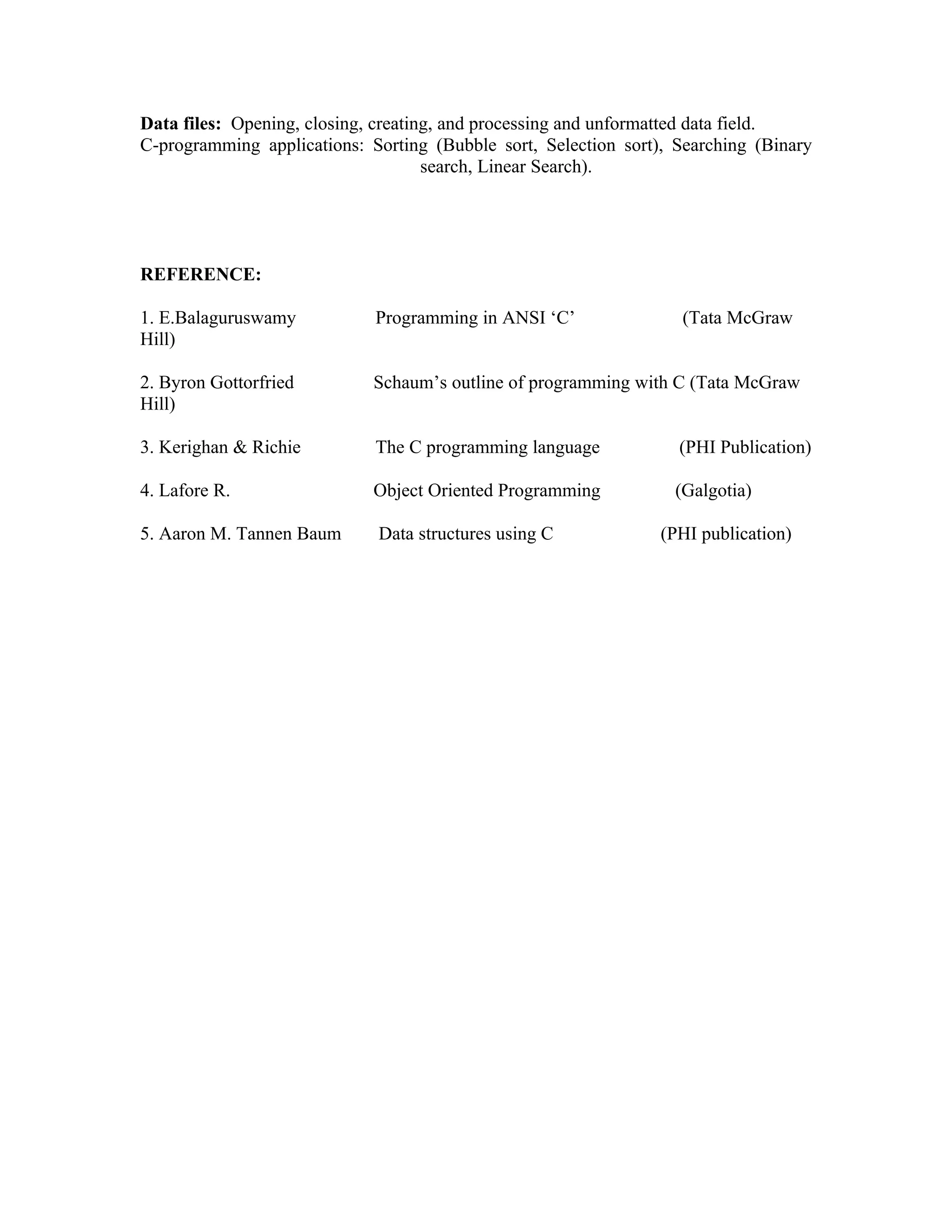
Fundamentals: Character set, Identifiers & Keywords, Data Types, constants, set,
constants, variables, expressions, statement, symbolic constants. Operations and
expressions: Arithmetic operators, unary operators, relational and logical operators,
assignment and conditional operators, and library functions.

Data input and output: Preliminaries, single character input, single character output,
entering input data, more about the scanf() function, writing output data, more about
printf function, the gets and puts function, interactive programming.

Control statements: Preliminaries, while, do-while and for statements. Nested loops, if
else, switch, break continue statement.

Functions: Brief overview, defining accessing function, passing perimeters to function,
specifying argument data types, function prototype and recursion.

Program structure: Storage classes, automatic, external, and static variables, more
about library functions.

Array: defining and processing an array, passing pointers to a function, pointer and one
dimensional arrays, operations on pointers, passing functions multidimensional arrays of
pointers, passing functions to the other functions, more about pointer declarations.

Structure And Unions: Defining and processing a structure, user defined data types,
structure and Pointers, passing structure to function, self-referential structures, unions.
Data files: Opening, closing, creating, and processing and unformatted data field.
C-programming applications: Sorting (Bubble sort, Selection sort), Searching (Binary
                                     search, Linear Search).


REFERENCE:

1. E.Balaguruswamy           Programming in ANSI ‘C’               (Tata McGraw
Hill)

2. Byron Gottorfried         Schaum’s outline of programming with C (Tata McGraw
Hill)

3. Kerighan & Richie         The C programming language            (PHI Publication)

4. Lafore R.                 Object Oriented Programming          (Galgotia)

5. Aaron M. Tannen Baum      Data structures using C             (PHI publication)
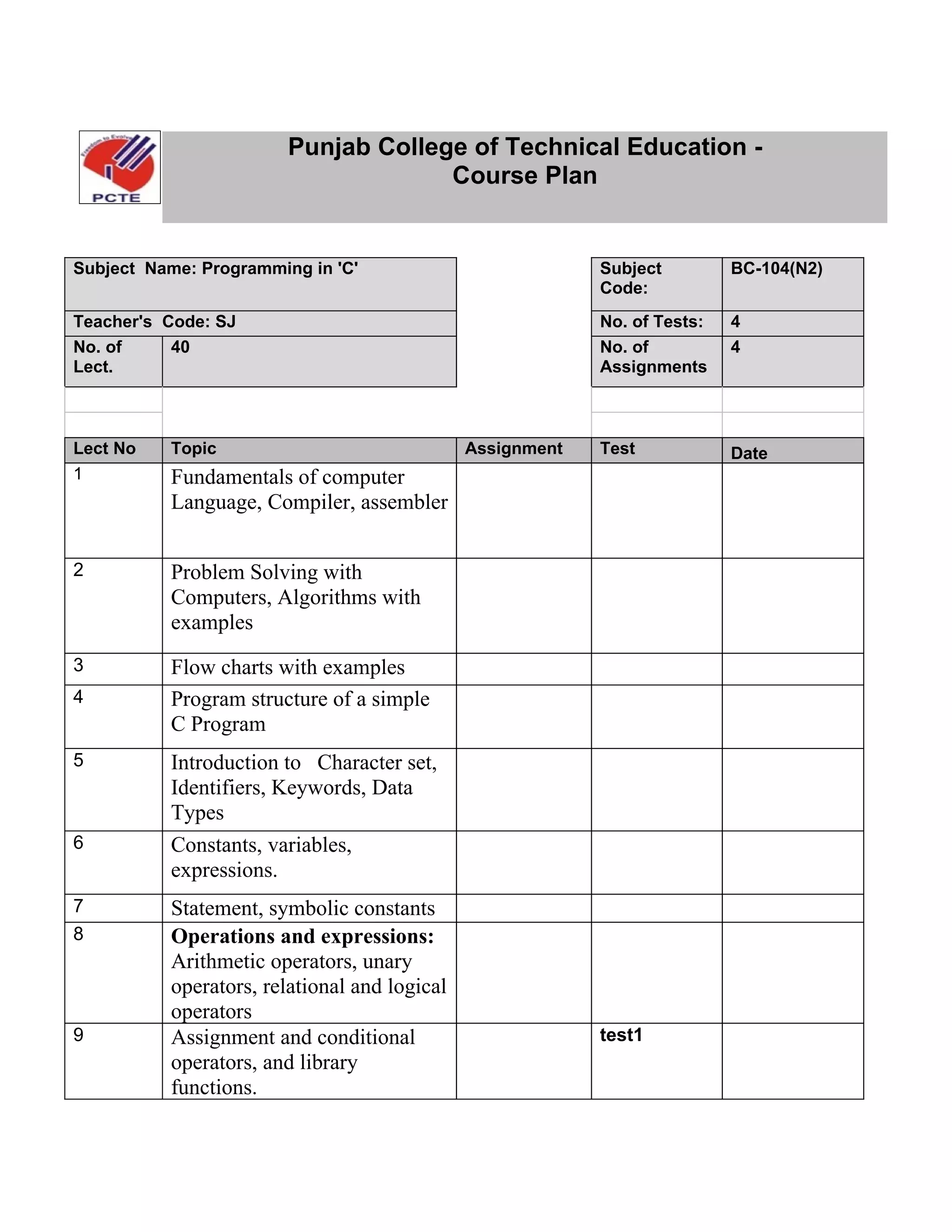
Punjab College of Technical Education -
                                     Course Plan


Subject Name: Programming in 'C'                           Subject         BC-104(N2)
                                                           Code:
Teacher's Code: SJ                                         No. of Tests:   4
No. of     40                                              No. of          4
Lect.                                                      Assignments


Lect No   Topic                               Assignment   Test            Date
1         Fundamentals of computer
          Language, Compiler, assembler


2         Problem Solving with
          Computers, Algorithms with
          examples
3         Flow charts with examples
4         Program structure of a simple
          C Program
5         Introduction to Character set,
          Identifiers, Keywords, Data
          Types
6         Constants, variables,
          expressions.
7         Statement, symbolic constants
8         Operations and expressions:
          Arithmetic operators, unary
          operators, relational and logical
          operators
9         Assignment and conditional                       test1
          operators, and library
          functions.
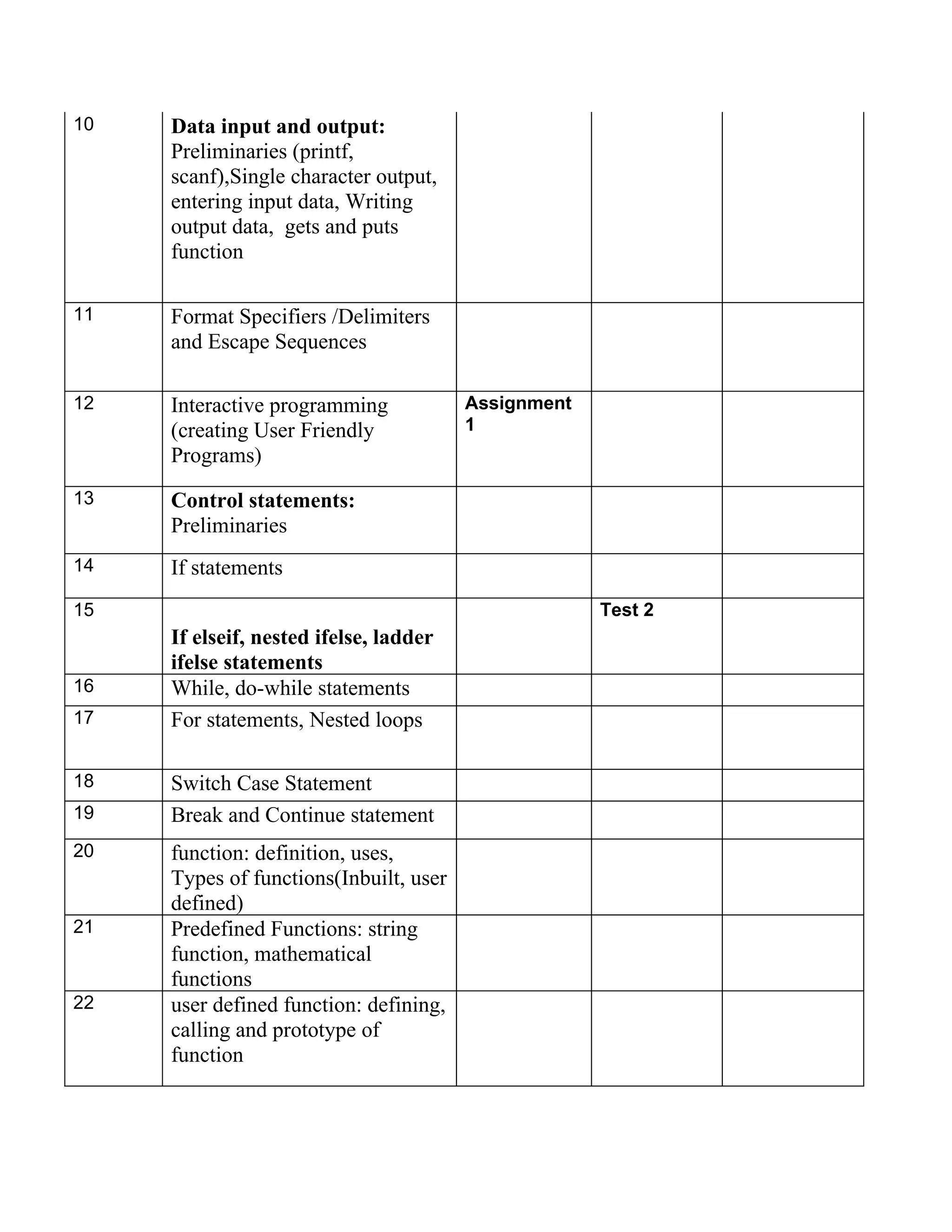
10   Data input and output:
     Preliminaries (printf,
     scanf),Single character output,
     entering input data, Writing
     output data, gets and puts
     function

11   Format Specifiers /Delimiters
     and Escape Sequences

12   Interactive programming            Assignment
     (creating User Friendly            1
     Programs)
13   Control statements:
     Preliminaries
14   If statements
15                                                   Test 2
     If elseif, nested ifelse, ladder
     ifelse statements
16   While, do-while statements
17   For statements, Nested loops

18   Switch Case Statement
19   Break and Continue statement
20   function: definition, uses,
     Types of functions(Inbuilt, user
     defined)
21   Predefined Functions: string
     function, mathematical
     functions
22   user defined function: defining,
     calling and prototype of
     function
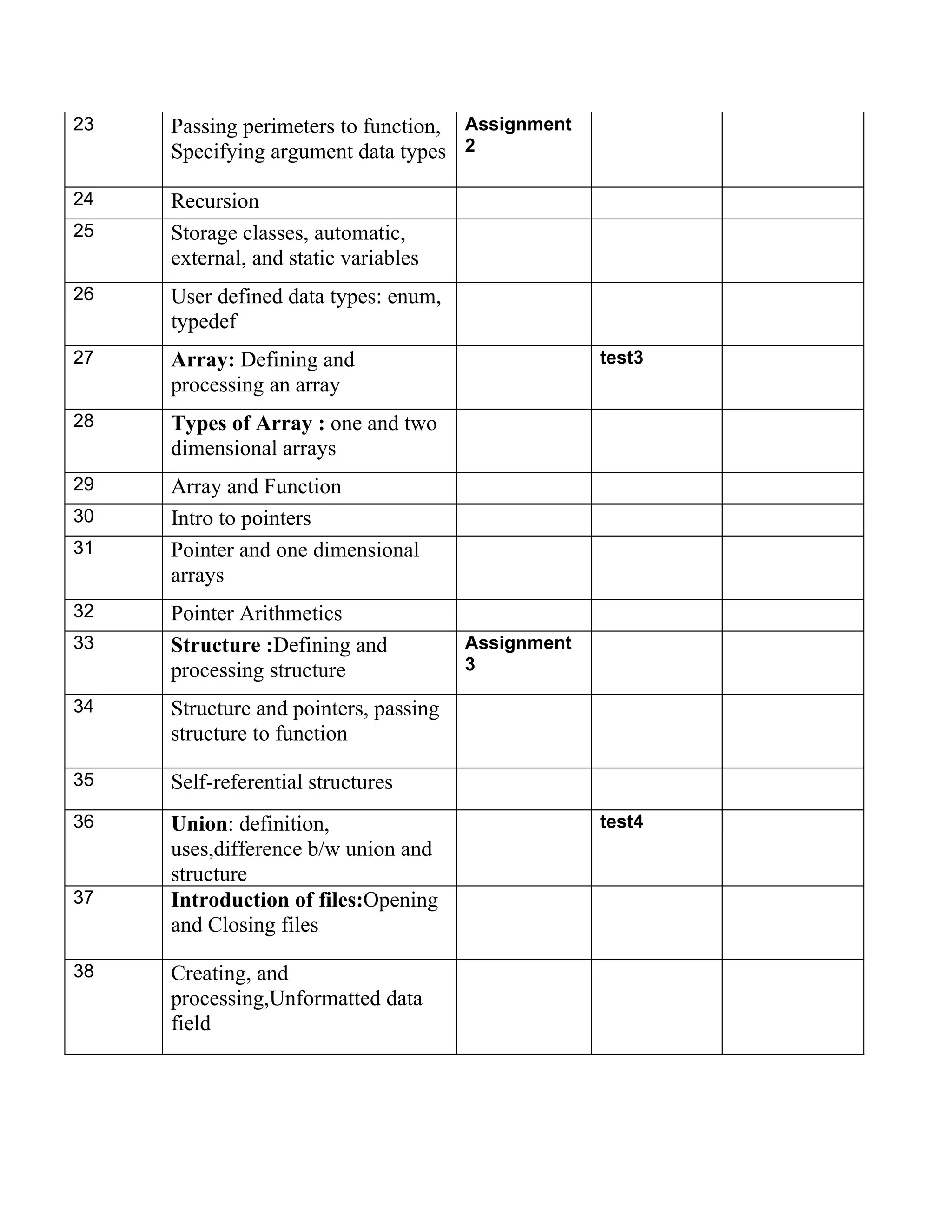
23   Passing perimeters to function, Assignment
     Specifying argument data types 2

24   Recursion
25   Storage classes, automatic,
     external, and static variables
26   User defined data types: enum,
     typedef
27   Array: Defining and                            test3
     processing an array
28   Types of Array : one and two
     dimensional arrays
29   Array and Function
30   Intro to pointers
31   Pointer and one dimensional
     arrays
32   Pointer Arithmetics
33   Structure :Defining and           Assignment
     processing structure              3

34   Structure and pointers, passing
     structure to function

35   Self-referential structures
36   Union: definition,                             test4
     uses,difference b/w union and
     structure
37   Introduction of files:Opening
     and Closing files

38   Creating, and
     processing,Unformatted data
     field
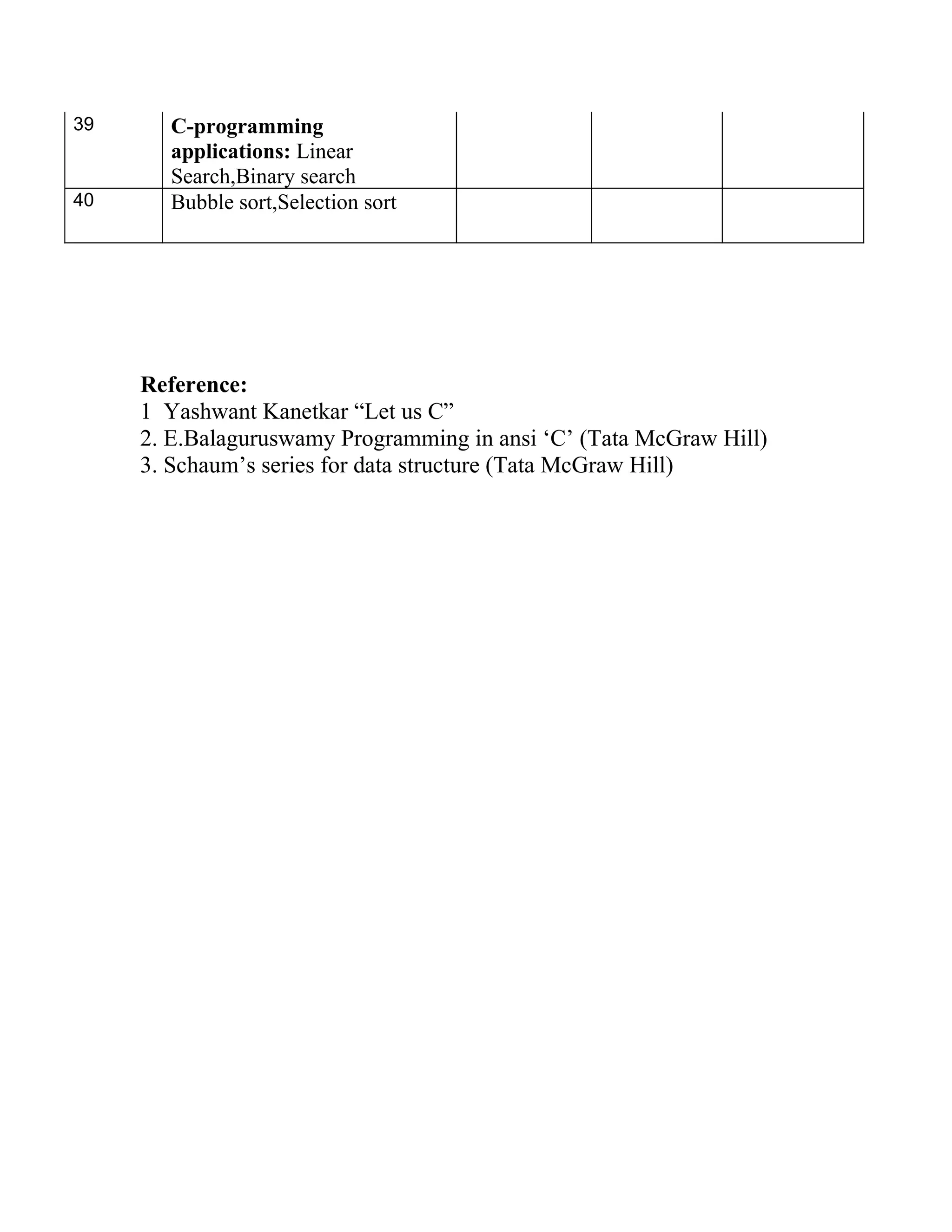
39     C-programming
       applications: Linear
       Search,Binary search
40     Bubble sort,Selection sort


     Reference:
     1 Yashwant Kanetkar “Let us C”
     2. E.Balaguruswamy Programming in ansi ‘C’ (Tata McGraw Hill)
     3. Schaum’s series for data structure (Tata McGraw Hill)
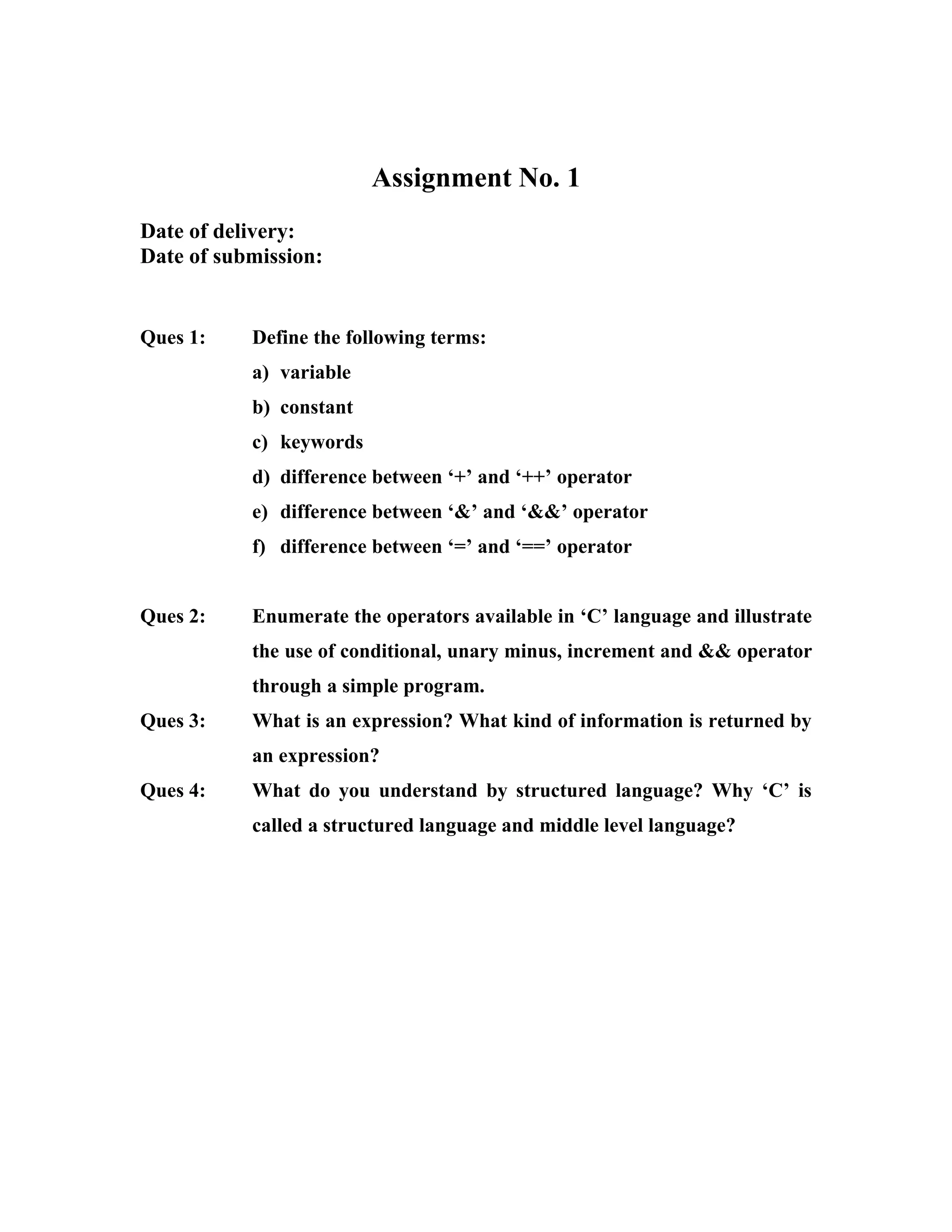
Assignment No. 1
Date of delivery:
Date of submission:


Ques 1:    Define the following terms:
           a) variable
           b) constant
           c) keywords
           d) difference between ‘+’ and ‘++’ operator
           e) difference between ‘&’ and ‘&&’ operator
           f) difference between ‘=’ and ‘==’ operator


Ques 2:    Enumerate the operators available in ‘C’ language and illustrate
           the use of conditional, unary minus, increment and && operator
           through a simple program.
Ques 3:    What is an expression? What kind of information is returned by
           an expression?
Ques 4:    What do you understand by structured language? Why ‘C’ is
           called a structured language and middle level language?
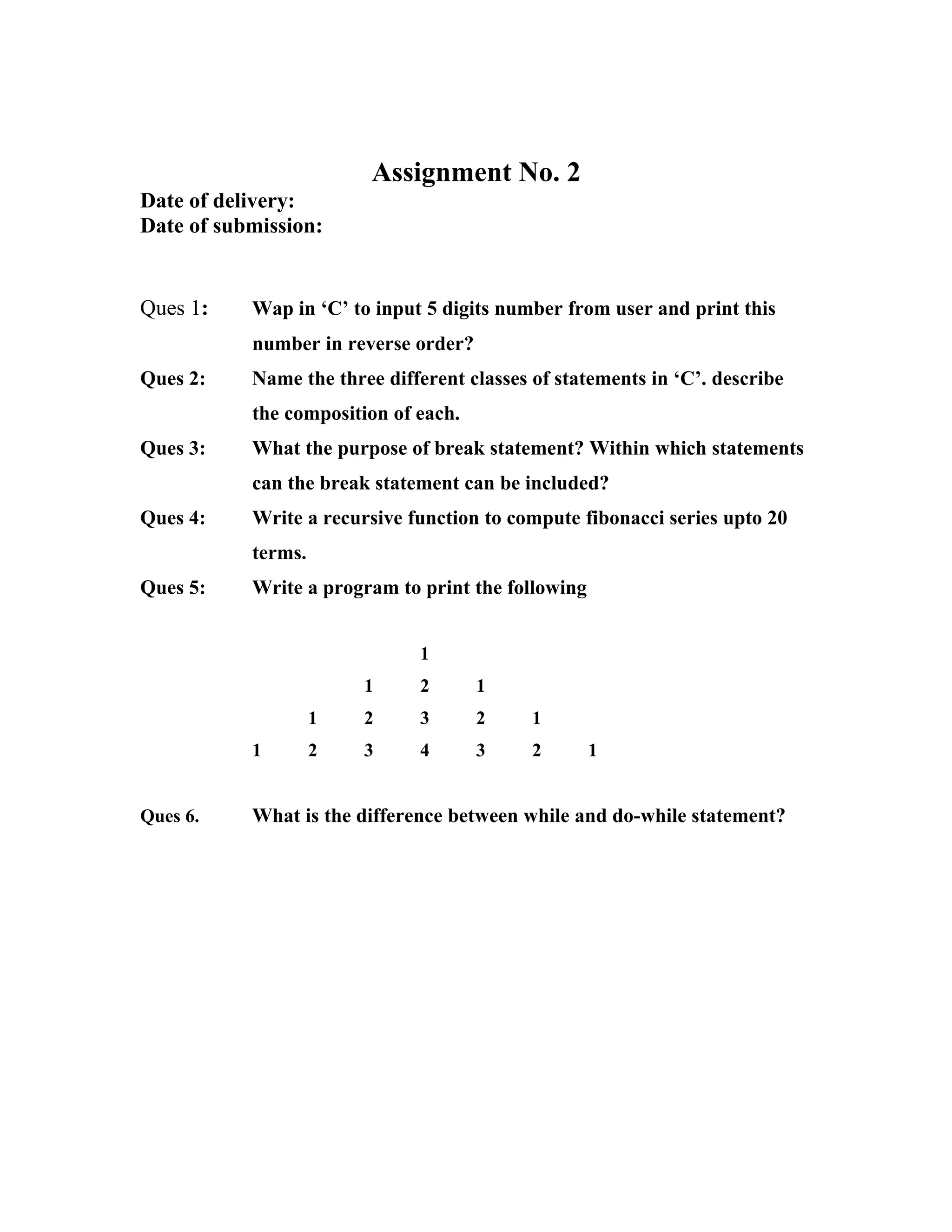
Assignment No. 2
Date of delivery:
Date of submission:


Ques 1:    Wap in ‘C’ to input 5 digits number from user and print this
           number in reverse order?
Ques 2:    Name the three different classes of statements in ‘C’. describe
           the composition of each.
Ques 3:    What the purpose of break statement? Within which statements
           can the break statement can be included?
Ques 4:    Write a recursive function to compute fibonacci series upto 20
           terms.
Ques 5:    Write a program to print the following


                              1
                        1     2       1
                    1   2     3       2     1
           1        2   3     4       3     2       1


Ques 6.    What is the difference between while and do-while statement?
Assignment No. 3
Date of delivery:
Date of submission:


Ques 1:    Assuming That The Data Consist Of 100 Positive Integers In
           The Range Of 0 To 25, Write A Program In C That Prints The
           Number Of Times Each Of The Integers Occurs In The Input?
Ques 2:    Explain the difference between structure and union?
Ques 3:    WAP to sort the elements of an array by using selection sort and
           bubble sort.
Ques 4:    WAP to search an element from an array by using binary
           search.
Ques 5:    WAP to multiply two matrices.
Presentation Topics

1.       Algorithms and Flowcharts
2. Fundamentals: Character set, Identifiers & Keywords, Data Types,
      constants, set, constants, variables, expressions, statement, symbolic
      constants
3. Operations and expressions: Arithmetic operators, unary operators,
      relational and logical operators, assignment and conditional operators,
4.       Library functions
5. Data input and output: Preliminaries, single character input, single
      character output, entering input data, more about the scanf function, writing
      output data,
6.       String functions
7.       If else statements
8. While, do-while and for statements
9.       Nested loops
10.       Switch,
11.       Break continue statement
12.       Functions
13.       Recursion.
14. Storage classes: automatic, external, and static variables
15.      Array: one, two and multi dimensional array.
16. Passing pointers to a function, pointer and one dimensional arrays
17. Passing functions multidimensional arrays of pointers, passing functions to
      the other functions
18. Structure And Unions: Defining and processing a structure, user defined
    data types, structure and Pointers, passing structure to function, self-
    referential structures, unions.
19. Data files: Opening, closing, creating, and processing and unformatted data
    field.
20. Sorting (Bubble sort, Selection sort), Searching (Binary search, Linear
    Search).

Coursebreakup

  • 1.
    PUNJAB COLLEGE OFTECHNICAL EDUCATION, LUDHIANA COURSE PLAN Name of Teacher: Sandeepjit Kaur Subject Name: Programming in ‘C’ Email Id: sandeepjit@pcte.edu.in Subject Code: BC-104 (N2) Assignments: 3 Total Lectures: 40 Tests: 4 Revision Lectures: 4 Max. Marks 100 Internal Assessment 40 External Assessment 60 Instructions for Candidates Candidates are required to attempt four questions from section B and the entire section A. Use of non-programmable scientific calculator is allowed. Fundamentals: Character set, Identifiers & Keywords, Data Types, constants, set, constants, variables, expressions, statement, symbolic constants. Operations and expressions: Arithmetic operators, unary operators, relational and logical operators, assignment and conditional operators, and library functions. Data input and output: Preliminaries, single character input, single character output, entering input data, more about the scanf() function, writing output data, more about printf function, the gets and puts function, interactive programming. Control statements: Preliminaries, while, do-while and for statements. Nested loops, if else, switch, break continue statement. Functions: Brief overview, defining accessing function, passing perimeters to function, specifying argument data types, function prototype and recursion. Program structure: Storage classes, automatic, external, and static variables, more about library functions. Array: defining and processing an array, passing pointers to a function, pointer and one dimensional arrays, operations on pointers, passing functions multidimensional arrays of pointers, passing functions to the other functions, more about pointer declarations. Structure And Unions: Defining and processing a structure, user defined data types, structure and Pointers, passing structure to function, self-referential structures, unions.
  • 2.
    Data files: Opening,closing, creating, and processing and unformatted data field. C-programming applications: Sorting (Bubble sort, Selection sort), Searching (Binary search, Linear Search). REFERENCE: 1. E.Balaguruswamy Programming in ANSI ‘C’ (Tata McGraw Hill) 2. Byron Gottorfried Schaum’s outline of programming with C (Tata McGraw Hill) 3. Kerighan & Richie The C programming language (PHI Publication) 4. Lafore R. Object Oriented Programming (Galgotia) 5. Aaron M. Tannen Baum Data structures using C (PHI publication)
  • 3.
    Punjab College ofTechnical Education - Course Plan Subject Name: Programming in 'C' Subject BC-104(N2) Code: Teacher's Code: SJ No. of Tests: 4 No. of 40 No. of 4 Lect. Assignments Lect No Topic Assignment Test Date 1 Fundamentals of computer Language, Compiler, assembler 2 Problem Solving with Computers, Algorithms with examples 3 Flow charts with examples 4 Program structure of a simple C Program 5 Introduction to Character set, Identifiers, Keywords, Data Types 6 Constants, variables, expressions. 7 Statement, symbolic constants 8 Operations and expressions: Arithmetic operators, unary operators, relational and logical operators 9 Assignment and conditional test1 operators, and library functions.
  • 4.
    10 Data input and output: Preliminaries (printf, scanf),Single character output, entering input data, Writing output data, gets and puts function 11 Format Specifiers /Delimiters and Escape Sequences 12 Interactive programming Assignment (creating User Friendly 1 Programs) 13 Control statements: Preliminaries 14 If statements 15 Test 2 If elseif, nested ifelse, ladder ifelse statements 16 While, do-while statements 17 For statements, Nested loops 18 Switch Case Statement 19 Break and Continue statement 20 function: definition, uses, Types of functions(Inbuilt, user defined) 21 Predefined Functions: string function, mathematical functions 22 user defined function: defining, calling and prototype of function
  • 5.
    23 Passing perimeters to function, Assignment Specifying argument data types 2 24 Recursion 25 Storage classes, automatic, external, and static variables 26 User defined data types: enum, typedef 27 Array: Defining and test3 processing an array 28 Types of Array : one and two dimensional arrays 29 Array and Function 30 Intro to pointers 31 Pointer and one dimensional arrays 32 Pointer Arithmetics 33 Structure :Defining and Assignment processing structure 3 34 Structure and pointers, passing structure to function 35 Self-referential structures 36 Union: definition, test4 uses,difference b/w union and structure 37 Introduction of files:Opening and Closing files 38 Creating, and processing,Unformatted data field
  • 6.
    39 C-programming applications: Linear Search,Binary search 40 Bubble sort,Selection sort Reference: 1 Yashwant Kanetkar “Let us C” 2. E.Balaguruswamy Programming in ansi ‘C’ (Tata McGraw Hill) 3. Schaum’s series for data structure (Tata McGraw Hill)
  • 7.
    Assignment No. 1 Dateof delivery: Date of submission: Ques 1: Define the following terms: a) variable b) constant c) keywords d) difference between ‘+’ and ‘++’ operator e) difference between ‘&’ and ‘&&’ operator f) difference between ‘=’ and ‘==’ operator Ques 2: Enumerate the operators available in ‘C’ language and illustrate the use of conditional, unary minus, increment and && operator through a simple program. Ques 3: What is an expression? What kind of information is returned by an expression? Ques 4: What do you understand by structured language? Why ‘C’ is called a structured language and middle level language?
  • 8.
    Assignment No. 2 Dateof delivery: Date of submission: Ques 1: Wap in ‘C’ to input 5 digits number from user and print this number in reverse order? Ques 2: Name the three different classes of statements in ‘C’. describe the composition of each. Ques 3: What the purpose of break statement? Within which statements can the break statement can be included? Ques 4: Write a recursive function to compute fibonacci series upto 20 terms. Ques 5: Write a program to print the following 1 1 2 1 1 2 3 2 1 1 2 3 4 3 2 1 Ques 6. What is the difference between while and do-while statement?
  • 9.
    Assignment No. 3 Dateof delivery: Date of submission: Ques 1: Assuming That The Data Consist Of 100 Positive Integers In The Range Of 0 To 25, Write A Program In C That Prints The Number Of Times Each Of The Integers Occurs In The Input? Ques 2: Explain the difference between structure and union? Ques 3: WAP to sort the elements of an array by using selection sort and bubble sort. Ques 4: WAP to search an element from an array by using binary search. Ques 5: WAP to multiply two matrices.
  • 10.
    Presentation Topics 1. Algorithms and Flowcharts 2. Fundamentals: Character set, Identifiers & Keywords, Data Types, constants, set, constants, variables, expressions, statement, symbolic constants 3. Operations and expressions: Arithmetic operators, unary operators, relational and logical operators, assignment and conditional operators, 4. Library functions 5. Data input and output: Preliminaries, single character input, single character output, entering input data, more about the scanf function, writing output data, 6. String functions 7. If else statements 8. While, do-while and for statements 9. Nested loops 10. Switch, 11. Break continue statement 12. Functions 13. Recursion. 14. Storage classes: automatic, external, and static variables 15. Array: one, two and multi dimensional array. 16. Passing pointers to a function, pointer and one dimensional arrays 17. Passing functions multidimensional arrays of pointers, passing functions to the other functions 18. Structure And Unions: Defining and processing a structure, user defined data types, structure and Pointers, passing structure to function, self- referential structures, unions. 19. Data files: Opening, closing, creating, and processing and unformatted data field. 20. Sorting (Bubble sort, Selection sort), Searching (Binary search, Linear Search).